
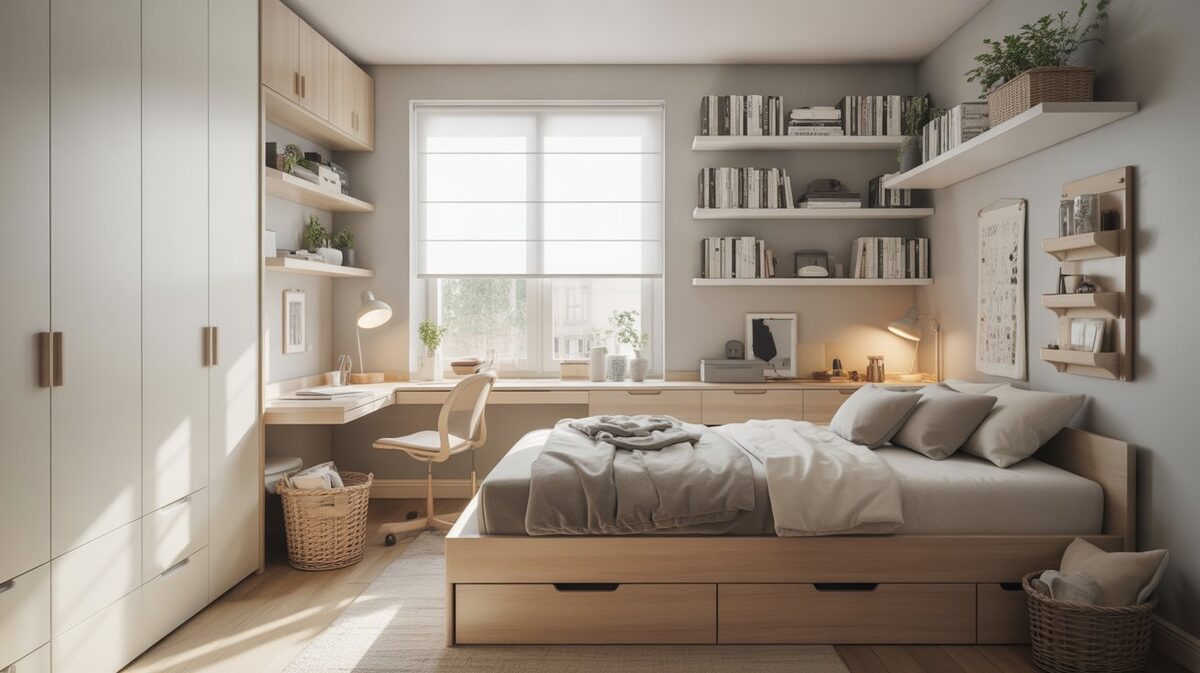
A small bedroom does not fail because it is small. It fails because everything in it is slightly too big, slightly in the way, and stored wherever it first landed. Organizing one is a measurements job before it is a shopping job: get the clearances right, give each category a sized home, and the room stays organized on its own.
This plan works through a small bedroom zone by zone, bed, wardrobe, desk, floor and walls, with the actual numbers: how much clearance furniture needs, what size storage fits where, and the order to do the work in.
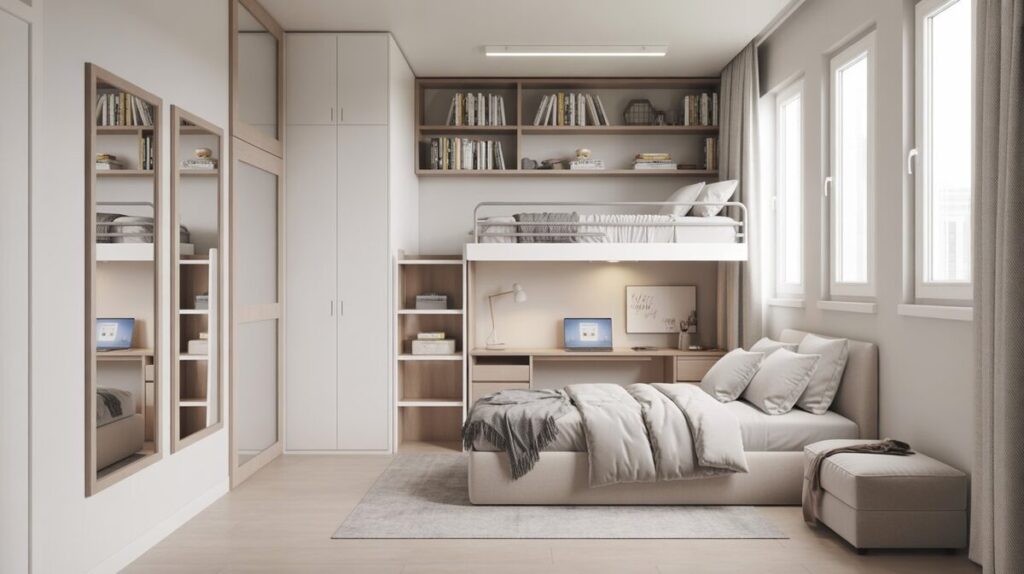
The Measurements That Govern Everything
- Walkways: 60 cm is the minimum comfortable clearance beside a bed and in front of a wardrobe; 75 cm feels generous. Below 50 cm, a space reads as an obstacle course.
- Bed sizes: a single is 90 by 190 cm, a small double 120 by 190, a standard double 140 by 190 (US full 137 by 191), a queen 150 to 160 wide. In a room under 9 square metres, a small double with storage usually beats a queen without.
- Wardrobe depth: hanging clothes need 55 to 60 cm of depth. Shelves and drawers work at 35 to 45 cm. If a wardrobe is shallower than 50 cm, hangers will angle and doors will fight the clothes.
- Desk: 100 to 120 cm wide and 50 to 60 cm deep is a real workstation; 80 cm wide is the laptop-only minimum. Knee clearance 60 cm wide.
- Under-bed space: a standard bed base leaves 15 to 25 cm of height underneath. Measure yours before buying boxes; low-profile boxes are 15 cm, standard are 20 to 30 cm with lids and wheels.
Keep these numbers open while you read; every fix below uses them.
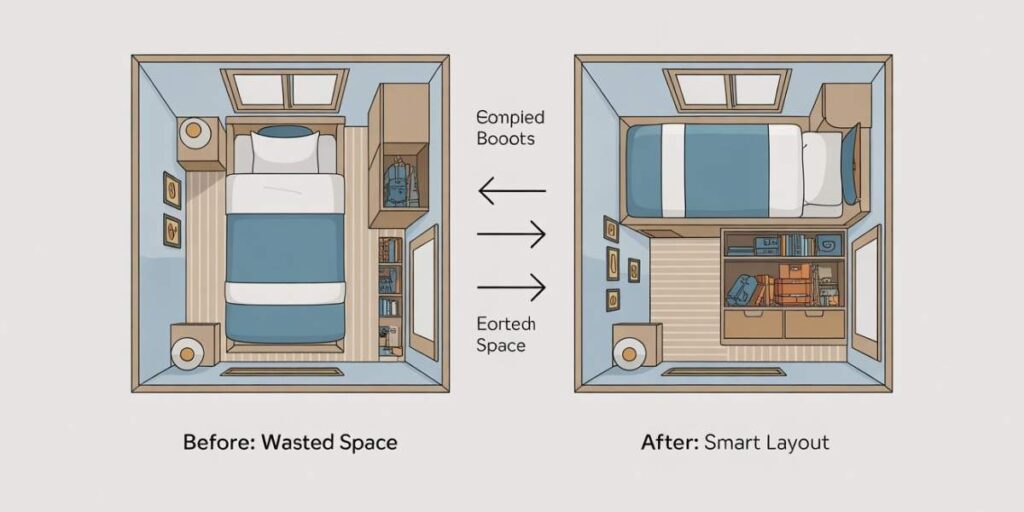
Step One: The Declutter, With an Actual Method
Do this before organizing anything, because organizing clutter just stores it neatly. Work category by category, not corner by corner, in this order: clothes, bedding and towels, papers and cables, then miscellaneous. Four boxes or bags: keep here, move to another room, donate/sell, bin. The small-bedroom rules:
- If it has not been used in a year and is not seasonal or sentimental-core, it goes.
- Duplicates shrink to the best one: two spare phone chargers in the drawer become one.
- Anything that belongs to another room leaves today, not into a “later” pile.
- Sentimental items get one box of a fixed size. When it is full, something leaves before something joins.
Most small bedrooms lose 20 to 30 percent of their contents in this pass, which is why the storage suddenly fits afterwards.
Zone 1: The Bed, the Biggest Storage You Own
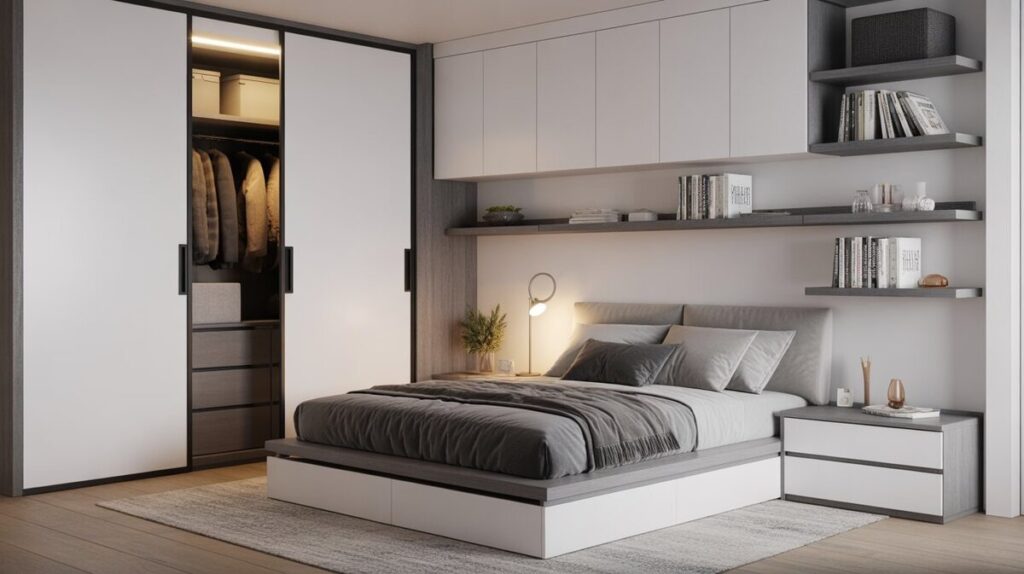
- A storage bed (ottoman or drawers) is the single biggest upgrade in a small bedroom: the footprint you already sleep on holds a season of clothes or all spare bedding. Ottoman bases lift the whole mattress and take bulky items; drawers suit daily-access things.
- No storage bed? Rolling boxes under it, sized to your measured clearance, one for off-season clothes, one for spare linens. Vacuum bags inside the boxes roughly halve the volume of duvets and winter clothes.
- Bedding discipline: two sets per bed, one on, one in the wash or the box. The third and fourth sets are what burst wardrobes.
- Bedside: one small table or a wall shelf at mattress height (about 55 to 65 cm from the floor) with a drawer or a tray. If a book, a charger, water and glasses do not fit on it, the floor becomes the second bedside table, and the room starts sliding.
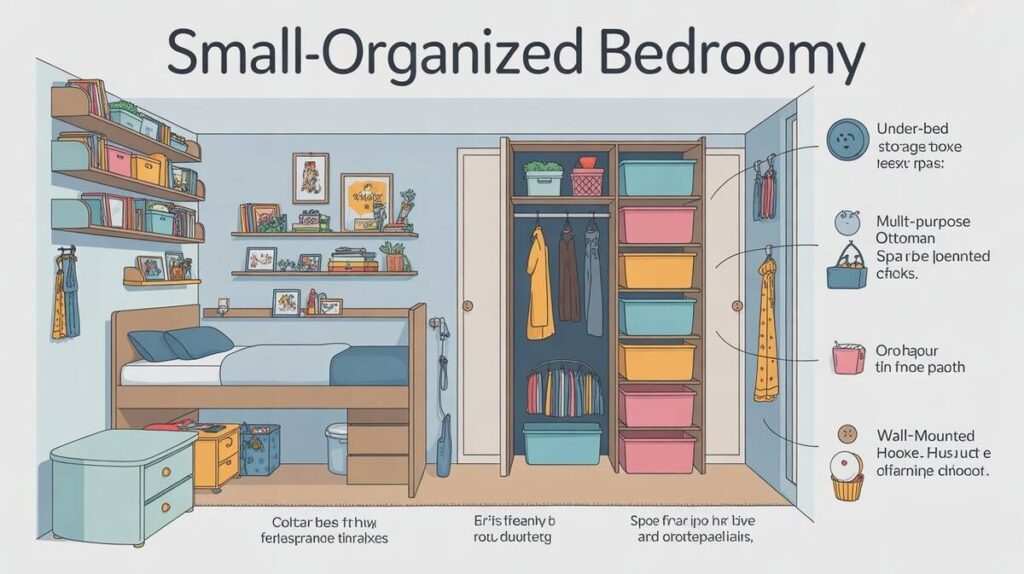
Zone 2: Clothes, a System Not a Pile
The full closet-planning method lives in our closet organization guide; the small-bedroom essentials are these:
- Double-hang where you can: two rails, one above the other, for shirts, tops and trousers folded over hangers. A second rail at about 100 cm and 200 cm heights doubles hanging in the same footprint.
- One category per shelf or drawer, with dividers or boxes inside drawers so categories cannot migrate.
- Doors and walls work too: hooks or a hanging organizer on the wardrobe or room door for bags, belts and tomorrow’s outfit.
- If the wardrobe itself is the problem, the fitted options in our bedroom wardrobe ideas guide show how sliding doors and floor-to-ceiling units change the arithmetic in small rooms: sliding doors alone return the 60 to 90 cm of swing space a hinged door eats.
- Chair rule: every small bedroom grows a clothes chair unless there is a hook rail for the worn-once category. Three hooks by the door kill the chairdrobe.
Zone 3: The Desk or Dressing Corner
- Put the desk on the wall nearest the window side light, not facing the bed if work stress follows you to sleep, and not blocking the wardrobe clearance.
- Everything on the desk gets a vertical home: a shelf above at 40 to 50 cm over the worktop, a monitor riser with the keyboard under it, cables in one tray.
- A mirror on the wall above a dressing-table desk doubles it as a getting-ready station so you do not need both pieces of furniture.
Zone 4: Walls, Doors and the Forgotten Surfaces
- Shelves above the door frame and high along one wall hold books and boxes where no furniture can stand. Keep them to one wall; shelves on every wall close the room in.
- The back of the door: a clear shoe organizer repurposed for chargers, accessories, scarves or cleaning supplies is 15 cm of storage most small bedrooms ignore.
- Picture ledges (10 cm deep) instead of deep shelves for books and frames keep walls useful without crowding the floor plan.
The Budget Version (Under $100)
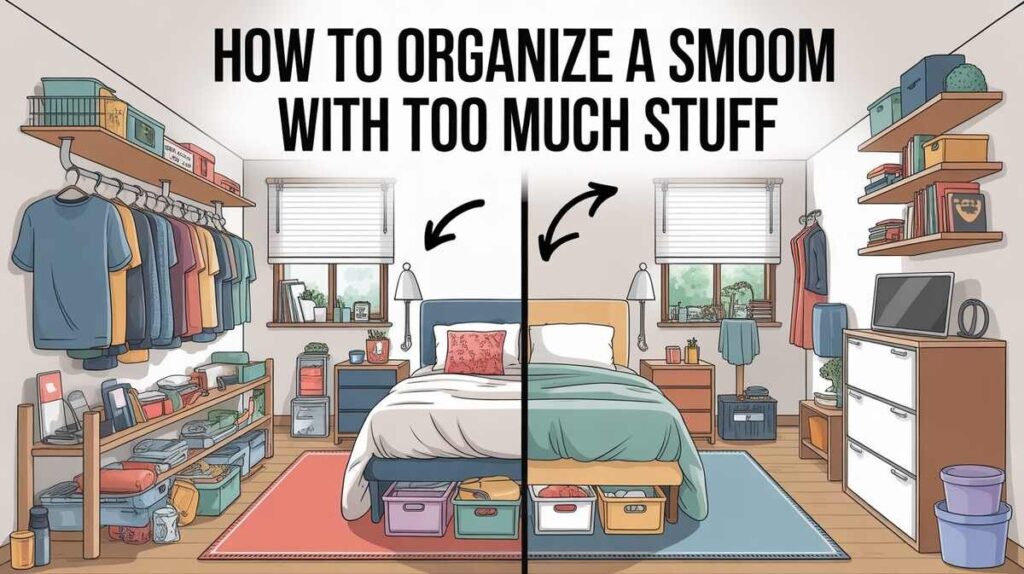
Rolling under-bed boxes ($20 to $40), a second hanging rail or a tension rod ($10 to $20), drawer dividers ($10), door hooks and a hook rail ($15), vacuum bags ($15), and one shelf with brackets ($20). Done in the right order, declutter first, measure, then buy, this tier delivers most of the result. Storage furniture comes after, only for the gaps the cheap tier cannot close.
The Weekend Order of Work
- Saturday morning: declutter by category, bags out of the house the same day.
- Saturday afternoon: measure clearances and under-bed height; list what storage the numbers allow.
- Sunday morning: fit rails, shelves, boxes and dividers; assign every kept category its home.
- Sunday afternoon: surfaces reset, floor completely clear, and labels or a photo of each drawer and box so the system is visible and stays.
Keeping It Organized: The 10-Minute Weekly Reset
Small bedrooms do not stay organized by willpower; they stay organized by a tiny routine: a 10-minute weekly reset returning everything to its assigned home, a one-in-one-out rule for clothes, and a rule that the floor is never a storage category. When a new object cannot be assigned a home in the plan, it is the signal to remove something else, not to add a pile.
Common Mistakes
- Buying storage before decluttering and measuring. The boxes that do not fit under the bed become the clutter.
- A bed too big for the room. Dropping from a queen to a small double returns a walkway and can return the room.
- Open piles as a system. If it is stored in a visible heap, it is not stored.
- Ignoring the door swing and wardrobe clearance when placing furniture. A beautiful layout you cannot open a drawer in fails by Friday.
- Matching containers everywhere. Uniform boxes look tidy in photos and waste space in real rooms; sizes should follow the categories, not each other.
Final Thoughts
Organize a small bedroom with numbers, not hope: declutter by category, respect the 60 cm clearances, turn the bed and the door and the high walls into storage, and give every category one sized home. Do it in that order and the room will stay the way you left it on Sunday.
Frequently Asked Questions
How do I organize a small bedroom with no closet?
Use a wardrobe with sliding doors (they need no swing space) or an open rail system with a curtain, under-bed boxes for off-season clothes, and a dresser whose drawers are divided by category. The zone system in this guide works without a built-in closet; only the furniture changes.
What size bed is best for a small bedroom?
The largest bed that still leaves 60 cm of clearance on both sides and at the foot. In rooms under 9 square metres that is usually a small double (120 cm wide), ideally a storage base, which returns more usable space than a bigger bed takes away.
How much clearance do you need around a bed?
Aim for 60 cm minimum on the sides you get in and out of, and at the foot; 75 cm feels comfortable. If one side must go against a wall, make it the side of the person who gets up less often, and keep the walkway side at full width.
How do I stop clothes piling up in a small bedroom?
Give the worn-once category a home: three hooks or a small rail by the door. Piles form where a category has no assigned place. Add a one-in-one-out rule for new clothes and a 10-minute weekly reset, and the pile loses its reason to exist.
What should I buy first to organize a small bedroom?
Nothing, until you have decluttered and measured. Then, in order: under-bed boxes sized to your clearance, a second hanging rail, drawer dividers, and door hooks. Those four, usually under $100 total, deliver most of the improvement.

Hi, I’m Ashir Zahid! I’m a home décor writer and creative enthusiast who loves finding simple and beautiful ways to make everyday spaces feel more comfortable and inviting. I enjoy exploring home styling ideas, practical decorating tips, and timeless trends that can work in real homes without making things feel complicated.
At DailyHomeVibe, I share easy-to-follow ideas for decorating different rooms, choosing the right colors and textures, and giving your home a fresh look with thoughtful details. My goal is to help readers find inspiration they can actually use, whether they are refreshing one small corner or giving their whole home a new feel.